
We arrive to Medellin after a (now considered quick) 6 hour micro-bus ride from Pereira. We’re staying with a couple I used to live with in Lima, Carol and Sebastian (Sebas), their now 2-year old son Maxi, and their cats Solomon and Catalina. They’ve literally just moved into a new apartment in the last week so we’re very grateful to them for putting us up! We’re with them for the weekend, and they kindly show us around some cool and tasty places to eat and drink. A favourite spot is a 20 minute drive into the winding outskirts of Medellin, where mansions instead of tower-blocks start populating the hillsides, and a sprawling biker-style cafe/bar/restaurant emerges surrounded by the lush green of Medellin. This place used to be a bike mechanics spot, with a cafe on the side for its clientele. But the cafe part of the business grew and grew until what it is now, still maintaining its biker image. We discuss how lush and green and gorgeous Medellin and Colombia is compared to the arid plains of Lima and Santiago (where Sebas is from).
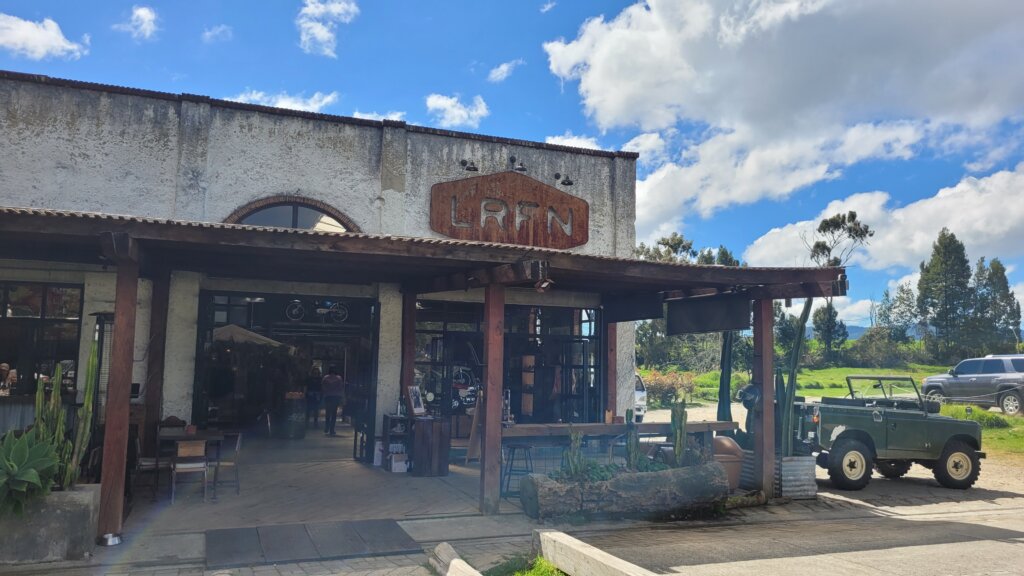

It’s been great to catch up with them after so many years and hear about their lives in Medellin. They’ve joined an apparently growing community of digital nomads, coming to live and work remotely from across the world. They have a wonderful life and Maxi is at a very cute age and obsessed with Totoro (they’re raising him right hehe). Sebastian even tempts James out for a late-night outdoor gym workout after we’ve filled up on pizzas and beer. Definitely an experience, and one I was happy to duck out of, for once!


Downtown
So far we’ve enjoyed the luxury of being driven about by Sebas and enjoying the amazing food and drink in and around the gentrifying El Poblado region. However, we reject Sebas’ offer to borrow his car (!) and opt for public transport, our second favourite nemesis, but preferable to trying to drive in Latin America!
Here, you can actually pay for public transport with cash, you don’t have to use their card system. However, for many reasons that made sense at the time, we opt for our new city ritual of “get the local transport card”. As is also now more often the case than not, my research isn’t up-to-date. The hour walk we do to the specific one-of-only-four ticket offices in the city is shut. The normal ticket office is open though, and so we still manage to get a transport card, just not the one we wanted (and it’s one we could have bought at the ticket office 20 minutes away, doh!). Considering our past escapades, we take this as a win.

It’s also given us a chance to experience the less pristine areas of Medellin that Carol and Sebas had warned us about. Sadly, we see many, ‘painfully’ homeless people. I say painfully, because many are clearly suffering with mental health or drug addiction. Painfully thin, filthy, often shoeless, some passed out face-down on the concrete, or aggressively talking to themselves or the hallucinations they are confronting. The impression we get is these homeless will take what they want from us, rather than beg for the money they desperately need, resulting in us feeling rather unsafe, picking up speed and slowing down to avoid being seen. It’s really sad to see at this level, and we are told that the pandemic has been the main cause of this now rather large population of lost souls. We are also incredibly aware that we’re the only gringos walking about, and all the horror stories we’ve read of crime in Colombia haunt us as we walk through very different parts of the city.
After a long day on our feet and feeling on edge, we return near the ‘safe’ zone and make a stop at another favourite city stop… a microbrewery. The place has tables out front on a quiet back road where we can relax and enjoy the peace, calm, and fresh air. The server is super friendly and helpful (and even helps with some English), and does us a special favour of letting us have a tasting palette to try some of the beers on offer, before we go large on a tropical number for James and a stout for me.

The downtown area is one we actually end up going back to the next day for our Real City Tour with Camilo (Milo). He starts us off with a history of the country, explaining the different chunks. The first part being when the city was founded and barely of any interest for a hundred years (no gold = no spanish interest). Due to this, there’s not a lot of old architecture around. The second period is of huge growth as the legal stimulant coffee becomes a huge industry. The third being another period of huge growth as the new illegal stimulant and guerilla groups in the outskirts displace many people coming to the relative ‘safety’ of the city. During this last period, Medellin was the second most dangerous place in the world after Somalia! Milo explains he will avoid saying the name of probably the most famous Colombian in the world, and this man will from now on in this blog be called Voldemort.
Of course, Colombia is most known for this third period and the Colombian Voldemort, but Milo is at pains to teach us about a (hopefully) fourth period of hope and change. But first, we go back in time to how the third period even came about. It wasn’t that Voldemort came from nowhere, a rogue violent terrorist with grand dreams who should be blamed for everything. No, Voldemort grew up and rose the ranks of already worsening criminal gangs, taking advantage of the illegal trade of now highly taxed cigarettes and alcohol. Things were already getting bad, but unfortunately for the Colombian people, he was definitely the wrong person to be rising the ranks at the wrong time. Learning how to corrupt, manipulate and intimidate, alongside the growing illegal drug boom from the USA and Europe. At the same time, the FARC guerillas are also increasing in power and terror, and they even start warring with the Medellin cartel. Realising the enemy of my enemy is my friend, they join forces, and the reign of real terror really takes hold.
Milo explains to us that there is not one, single, perspective of Voldemort or this third period. There’s no official line, story, or account. The people who are old enough to remember these times are glad for the peace they experience, and wish to forget him and the terror he fostered. The young, see him as a Robin Hood character, stealing from the rich (the USA I guess), to give to the poor (the Colombian people). When asked about how the government kept supporting the Colombian people without the drug money Voldemort had after he was gone, Milo counters the urban legend of what people think he did. Stories of him investing in schools, universities or hospitals are unproven, the only thing that can be verified is he built 300 homes, and contributed floodlights to a football pitch. Now whether this is some exceptional branding to keep the people on side through the hell they lived through, or places don’t want to admit they took his money, we’ll never know. What he certainly did do, is inject a lot of cash into the economy through bribes or payments of criminal activity. But I will side with the people who lived through that period, rather than a glamourised version without the fear and terror that came alongside.
Whilst this third period is considered to have largely ended with the death of Voldemort, the drug trade hasn’t. Accounting for approximately 2% of Colombian GDP back in Voldemort’s day, it now accounts for 4-5%. The violence and terror of this period wasn’t because of the drugs trade, but the person who was running it. What everyone in Colombia wants, is to be known as somewhere other than this third period.
And so, moving on to now. The Medellin government has invested a lot into improving the lives of its people, by investing in the worst off (one such example we visit in another tour that James will go into later). It’s termed social urbanisation and I’d highly recommend further reading. A (comparatively to our current government’s) novel approach of focusing on the poorest districts, establishing what is each district’s greatest need, and from their direction investing in infrastructure and projects of the greatest need, such as providing transport to remove social exclusion, and parks and libraries to provide education and culture. This isn’t a cookie-cutter plonk a green space into a rough neighbourhood approach and expect people to stop drug running, this is taking the time to understand the differing needs of differing communities to make sure the investments are in the right areas to make lasting change. Amazing. When you see a city go from one of the most dangerous places on Earth to what it is now, it really should give us hope that this can be done anywhere, if only we choose to.
For now, we’re downtown, being shown the result of some of these investments in this area, new government buildings, a square that used to be full of crime now full of bamboo trees, a forest of light poles and a public library, a transit system (including a cable-car) to connect “forgotten about” districts, a bike borrowing scheme that is free for locals, a beautiful square full of Botero sculptures with a curiously styled church, a grand shopping mall with art galleries on the top floors, and a protected historical mural showing the lives of the antioquian people.
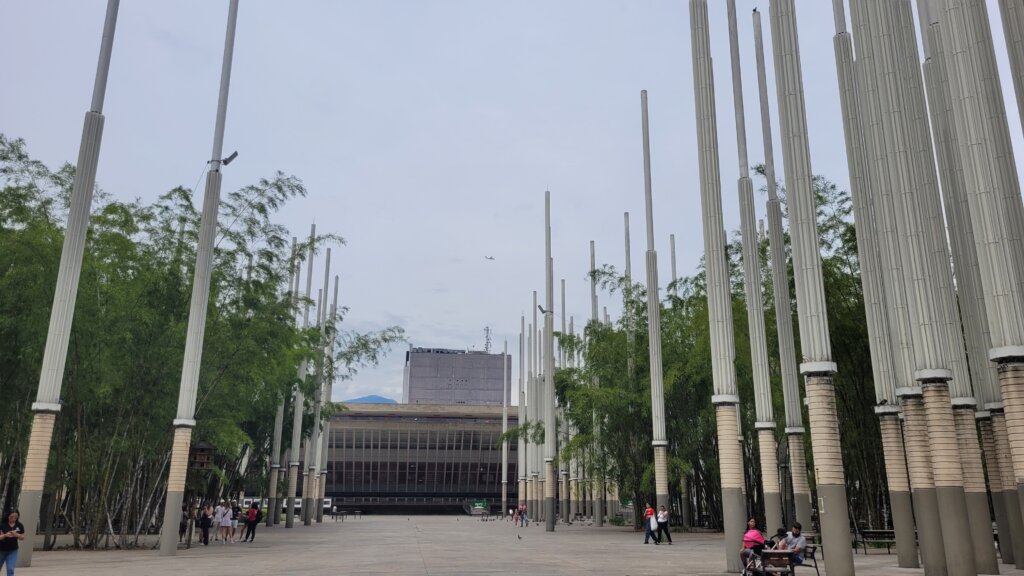
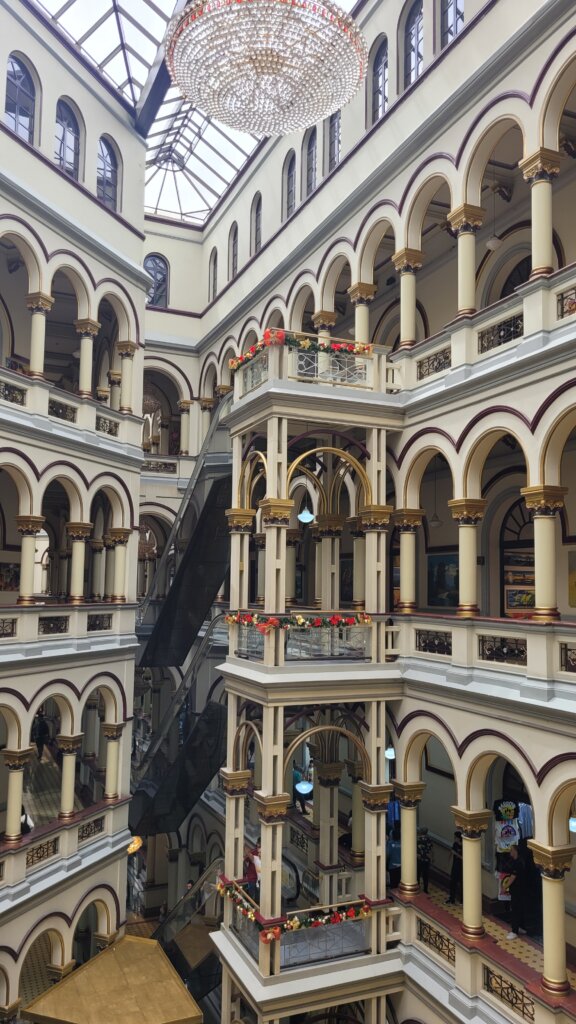


Life goes on, and the lives of the people here do so too, as they enjoy their Sundays in the many, many malls downtown. Milo tells us that part of the reason Colombians are so jovial and happy and friendly and love to dance and sing and smile is exactly because of all they have lived through. They don’t want to dwell on the past and wallow and cry, they want to celebrate and make the most of the lives they now get to enjoy. They want people to hear Colombia and think of dance, and coffee, and beauty, and happiness.

Unfortunately for Milo, our gringo experience of downtown is somewhat marred by a few sad encounters. We are clearly being watched, and are not very welcome here. I would say the looks are more of disdain than curiosity. Funnily enough, it’s similar to how I used to feel in La Paz, which I didn’t get this time around! As Milo shows us the mural and tells us about the investment into the metro, a homeless and high individual smashes a bottle behind our group, nicking the back of a girl’s bare leg. As we learn about Botero and his donations to the city, I see a man’s hand protrude out of an underground bin, like someone arising from a grave, as he pulls himself and some bags of rubbish out with him (in fairness to him, he is separating out plastic, I assume to make money from). As Milo tells us about how joyous life is now without violence, as the locals sing and dance in the square behind us, an intoxicated man joins our circle and decides to give his own welcome to Colombia (and then asks for money). And as we walk to our final spot, another homeless man demands what change we have. Thankfully Milo, being the front of the pack, shows us to ignore him, but if we had been alone, I am not sure what we would have done.
Back out of the crowds, we ask Milo how people feel about tourism here, and he’s honest enough to say that it’s gone into a bit of a dip. At first, the curiosity and intrigue meant we were welcomed and people were happy to see tourists. But now, class-wars, gentrification and wealth disparities (which we are a part of if not a huge contribution to), mean there’s a resentment we can certainly feel. Of course, this resentment isn’t why we’ve had these unfortunate experiences, that’s the bigger problem with glue addiction and homelessness. The hope is the newly elected mayor, who was a previously elected one and very successful at that, will help turn things back round again.
Milo ends the tour with two Botero statues. One that was blown apart by a bomb (left), and a replacement Botero provided after insisting the previous one remain (right), not to dwell on, but as a reminder of where Medellin has come from (a “monument to the country’s imbecility and criminality”) and a symbol of continued hope for the future they continue to build.

So, despite our personal challenges of this tour, it’s been good to help us understand where Medellin has come from, which will help us appreciate where it is now in Comuna 13 on our next tour. It’s also given us an introduction to Social Urbanisation that is clearly positively changing the fabric of Medellin society. Plus we’ve gotten a taste of an amazing lime and sugarcane drink made on the street, and got to see inside a mall we would never have ventured into without Milo’s guidance!
Once more we venture back to the relative safety of El Poblado where we check out a coffee shop Tim from Salento told us to go to for some ‘real, decent coffee’. It’s full of the digital nomads we heard about, and has lovely calm vibes as we sit upstairs on the balcony surrounded by greenery. James tries a coffee with soda combo (“curious”, “unusual”, “would recommend” – James), and I enjoy a frappe with all the trimmings. Refreshed once more, it’s time for us to say farewell to Carol, Sebas and Maxi and move to a hostel in a different part of town.

Comuna 13 (over to James)
We arrive by Metro to the San Javier station where our tour will begin. With a bit of time to kill, we find a nearby panadería and try a buñuelo, a couple of empanadas and a traditional Colombian churro. The buñuelo is a strange delicacy, a big ball of deep fried dough that tastes like a plain unsweetened donut, the inside filled with tasteless melted cheese. With full stomachs we hunt down our tour guide for the afternoon, a young dude called Andreas.
Taking a short, packed, sweaty metro bus we begin the tour with a lengthy history lesson. The jist is Comuna Trece (District Thirteen) was founded by the displaced people coming from the countryside, built on the Western edge of Medellin. Over time it was favoured by criminal gangs due to it’s easy access to the coast (for drug smuggling), height advantage to spot incoming police/raids and the many hideouts in the higgildy piggildy architecture. At the peak of the cartel violence it was a melting pot of seven conflicting factions, five fighting over the territory and the other two being the police and the paramilitary. It was so dangerous that only residents were allowed into the area. Any interlopers would likely be kidnapped and later killed, regardless of whether their ransom had be paid or not. Make no mistake, Comuna 13 was the most violent district in a very violent city. Now however, it has turned a corner and then some.

Our tour takes us through bustling markets selling trendy clothes, hats and souvenirs. The locals are friendly and most seem happy to see us spending time in their area. The roads are lined with some of the most beautiful street art I’ve ever seen, some is simple graffiti for basic expression (including one by our guide) but others have a deeper meaning. A particular open-air gallery features art depicting our connection to nature, inner peace, protecting pachamama and choosing love over violence.


Another huge influence on the area is the art of hip hop. As we make our way up we stop to watch locals freestyle rap along to words we shout at them.

We pass multiple dance groups body popping and genuinely looking like they are enjoying expressing themselves and making a few pesos doing something they love. We continue to ascend up using escalators provided by the government as a sign that the area is evolving and becoming a tourism hotspot. At the top of one of these is a famous piece of street art referencing Operation Orion.
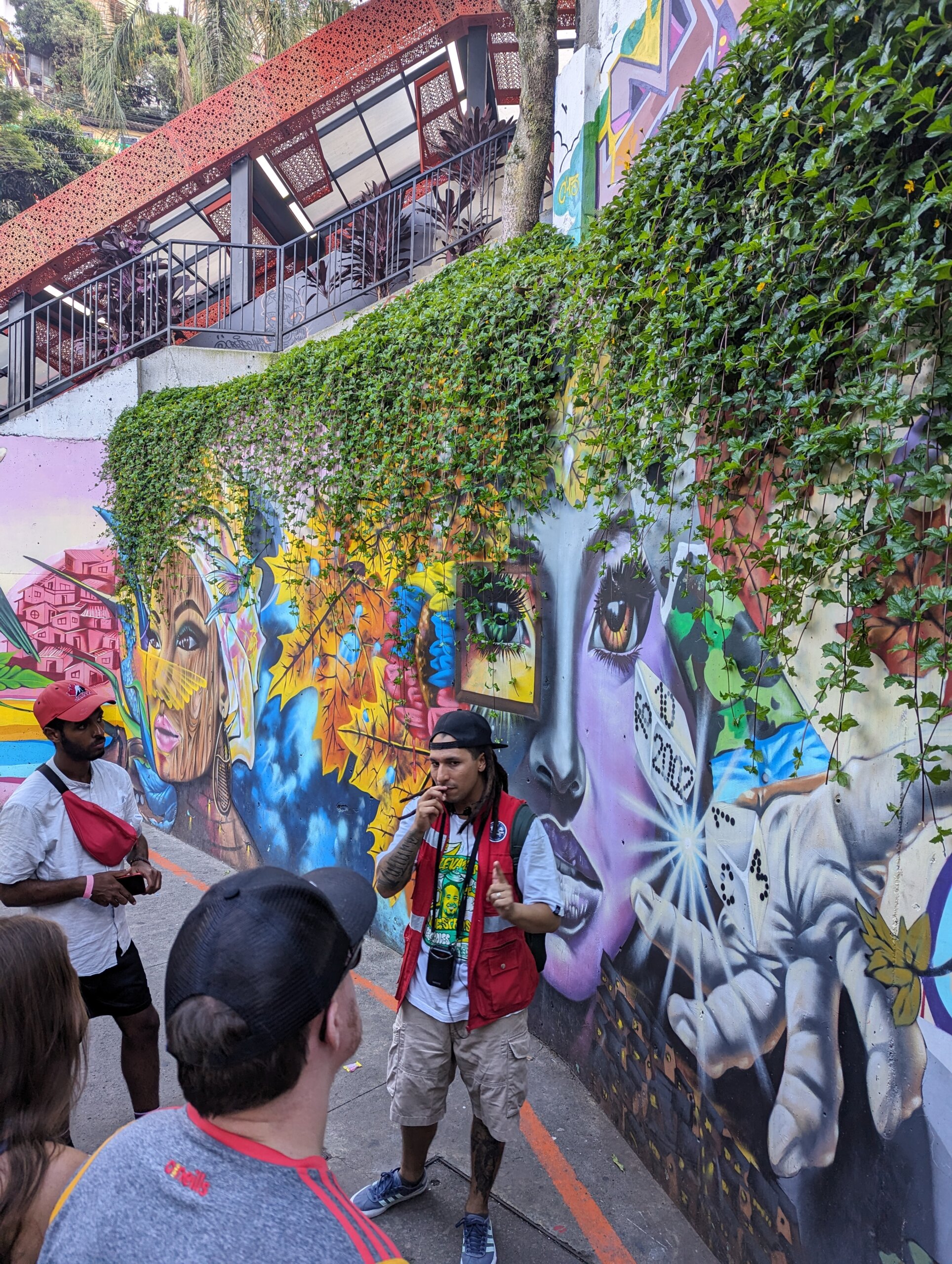
In the years before this military intervention, the violence was getting out of control, with several deaths per week in this small part of the city. The government decided to fight fire with fire in it’s seventeenth intervention in the district within two years. The true numbers will never be known but dozens of civilians were killed, innocent or otherwise, hundreds arrested and hundreds more ‘disappeared’.
As far as I understand, after these numerous aggressive interventions, the paramilitary group maintained control of the area. From around the this time in 2002, the area slowly moved away from the gangs, the guns, the drugs, the brutality towards art, music, dance, expression, freedom and hope. The reason behind the change was simply the local people innovating and inspiring each other to choose a different path for the future. The area is now at a delicate spot in time between a dark history and bountiful opportunities for the future. Alex rightly remarks the area is similar to how Camden used to be before it lost it’s underbelly of punk rock and rebellion. Gentrification here is already kicking in but the soul of the area remains, how much longer it can last until it is sold is uncertain.

The tour finishes at a craft beer bar overlooking the entire city as the sun sets. We enjoy a beer with Andreas and the rest of the group, the buzz and energy of the comuna still humming away in the background.
After dark, we make our way to the Xmas lights on the river in central Medellin. The theme this year is ‘100 years of Disney’. The first area is not as busy as we’d feared and we enjoy space to walk around and admire the lights, water and laser show, all celebrating famous Disney characters.


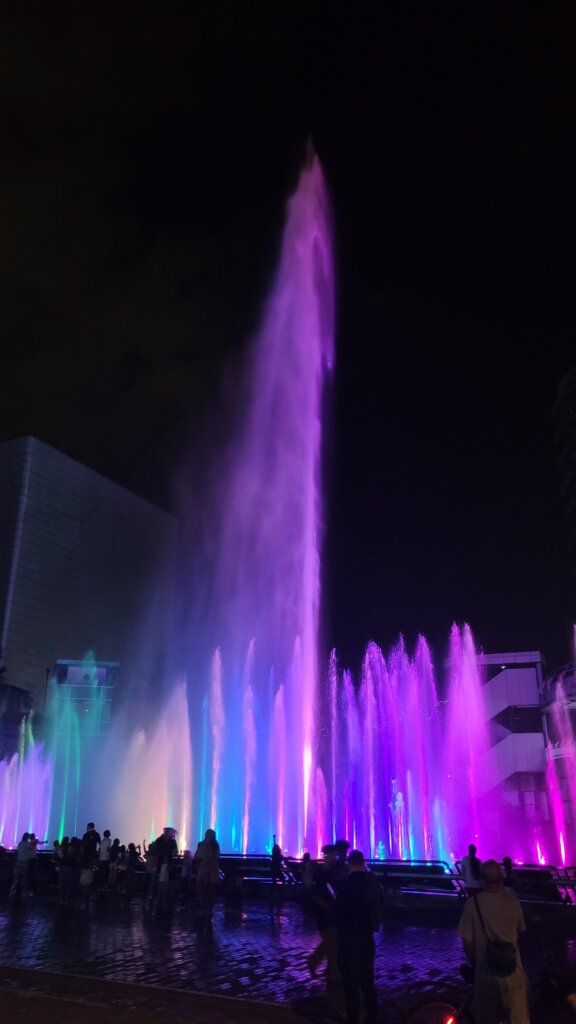
The second half is much more compact and we essentially queue along the river in a two person wide lane going both ways. Along this section are dozens of food, drink and toy vendors. Alex’s eyes light up when she spots a stall selling cups of roast potatoes and she can’t resist. To wash it down we enjoy more of the lime drink we sampled on our walking tour yesterday.
Our evening meal is at a lovely and calm rooftop bar close to our hostel. Though we’re both exhausted from a busy day we enjoy burger and chips and a pork dish before heading home and hitting the hay before an early start tomorrow. Back to Alex…
Guatapé and El Peñol (the rock)
Funnily enough, apparently one of the top things to do in Medellin is leave it, heading two hours out to a place called Guatape. This is more of a fun, pretty excursion than any history lesson, but our guide Marlon puts all his energy and enthusiasm into keeping his sleepy gringo guests entertained throughout the day.
Some info behind this stunning place:
- It’s the third largest rock in the world (after Uluru, Australia and Sugar Loaf, Brasil).
- The walk is 780 steps, and 280 metres up.
- The stunning setting is actually a human-made reservoir to generate electricity.
- This reservoir creates 5% of the energy Colombia uses, and they also export some.
- Before it was a reservoir, there was a town called Peñol of about 4000 people who were mostly farmers. Their land was flooded and they were relocated, but they had to find other livelihoods as they weren’t relocated with farms.
- Peñol is known as the phoenix, not born from the ashes, but from the water.
- The rock is owned by one family.
- Apparently 20,000 people climb the rock each day. It costs £5 each to climb it. You do the math.
- The family started painting Guatapé onto the side of the rock, but the people of Peñol were against it, so submitted a request for the rock to become a national monument so it could not be altered.
- Their request was approved mid-painting, with just the G and the left-most part of the U painted.
- As much as rock can’t be altered to complete the painting, it also can’t be altered to undo the painting, so it will forever say GI on it. Lol.
- The water of the reservoir is incredibly cold, and it is forbidden for anyone to swim in it.
- Apparently this is because people kept coming to Guatapé for fun and drinking and would end up in the lethal combo of drunk with cold shock.
- 90% of the town’s money comes from tourism. Each new building in the Guatape village has to have a unique zocalo (the artistic lower frieze).


Gym Bros and Bus Woes
Our last day is spent checking out a huge outdoor gym down the road from our hostel. It’s immense and this whole block has swimming pools, a race track, courts, pitches and even archery! For free! Another amazing example of the government investing in its people and their health and wellbeing and making these public spaces places to congregate rather than fear. There’s plenty of people making the most of the equipment with us, and we enjoy strengthening our weakening muscles, and marvel at the resourcefulness of the makeshift barbells from whey tubs filled with concrete.

For once, we are flying onwards instead of taking a lengthy bus, but we are determined to save some pennies by getting the local bus to the airport at least. We cram onto the first bus to take us to the mall it apparently starts from, but after an hour of running after a bus to be denied boarding, a subsequent one driving straight passed us, getting differing instructions of where to wait and seeing no more buses none more for 40 minutes, we give in and just do as the gringos do and take a cab (a yellow one! to avoid the Uber turmoils so far). We’re just grateful we’re able to fall back on this option, as we make it to the airport with plenty of time.
**************
Adventure – midnight gym session, staying with locals, loving the culture and vibe of comuna 13
Excitement – the sparkling sun glistening off the water on the boat trip of Guatapé, taking an organised tour so we can have a day off planning, sharing a beer with Andreas
Trauma – all the lost souls, wasting time and money failing to get a bus to the airport, sneaking into a taxi, an actual dead body being carried out of the elevator
1 Comment
Looks stunning. Those blue skies look particularly attractive as we approach the heart of winter here. Fascinating history to Medellin and inspirational approach to social development. Guatape looks good fun, love a good giant rock.